





Elective Visit to Newborn Screening Ontario
Submitted by Dr. Daniel Won-Shik Choi
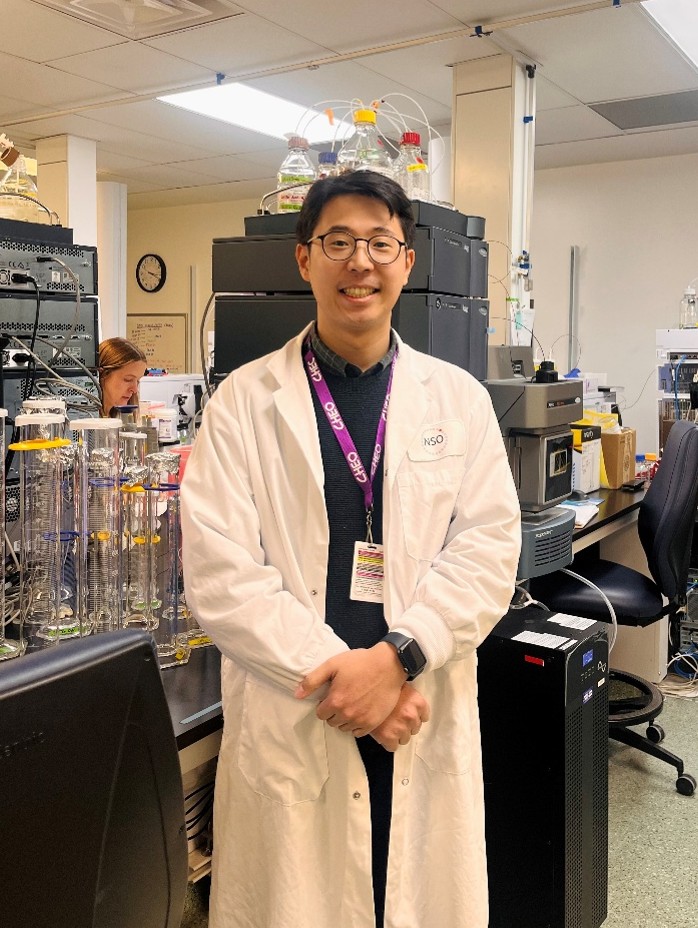
The CSCC Trainee Elective Visit Grant provides clinical biochemistry trainees with a unique learning opportunity for a short-term visit to laboratories outside their home training programs to gain exposure to specialized areas of laboratory medicine. I am very grateful to be a recipient of this grant, which allowed me to visit Newborn Screening Ontario (NSO), located at the Children’s Hospital of Eastern Ontario (CHEO) in Ottawa. In Ontario, newborn screening specimens are delivered to and processed centrally at NSO in Ottawa. This visit allowed me to see how newborn screening brings together laboratory testing, clinical follow-up, and public health dimensions. Unlike many laboratory tests ordered in the hospital in response to a specific clinical question, newborn screening is performed on asymptomatic newborns to identify infants at risk for serious but treatable conditions early enough to allow timely intervention. NSO screens approximately 150,000 newborns per year and serves Ontario, as well as Newfoundland and parts of Nunavut.
Going into the visit, I wanted to better understand:
- Total testing process – dried blood spot (DBS) collection, transport, receipt, processing, analysis, interpretation, reporting, and follow-up.
- Screening algorithm design – cutoffs, second- and third-tier testing to maximize screening performance
- Clinical biochemist’s role – quality oversight, interpretation, consultation, decision-making
Total Testing Process – Journey of Newborn’s Dried Blood Spot
My schedule for the week was thoughtfully organized by Dr. Nathalie Lepage (Clinical Biochemist) to provide both high-level program context and practical laboratory exposure. Throughout the week, I followed the journey of dried blood spot (DBS) specimens to better understand the total testing process. The workflow begins with pre-analytical steps, including DBS collection on filter paper cards at the birthing hospital and transport to NSO. I learned about Track-Kit, a Purolator tracking tool designed by STACS DNA in collaboration with NSO, which allows real-time sample-level tracking by linking newborn screening cards with Purolator package tracking information. Track-Kit helps minimize “missing” samples and supports daily sample volume forecasting.
Once received at NSO, specimens are assessed for quality. If the DBS specimen passes inspection, eleven 3.2-mm punches are generated from each card for downstream testing. The analytical phase involves a broad range of techniques, including immunoassay, enzymatic assays, liquid chromatography, mass spectrometry, and molecular testing. Each screening panel is carefully designed using a multiplexed strategy, with first-, second-, and third-tier biomarkers and appropriate cutoffs to optimize screening performance. Dr. Matthew Henderson (Laboratory Director) discussed how cutoffs are derived and how screening performance is continuously monitored and cutoffs are updated as needed.
In the post-analytical phase, abnormal or complex findings require review by a medical scientist before reporting. When a screen-positive result is identified, the process extends beyond the laboratory to referral to regional treatment centers, diagnostic evaluation by healthcare professionals, and feedback to NSO regarding the outcome. Most samples are received by day 4 of life, with initial first-tier results released by day 5 and final results released by day 7 for samples requiring additional testing for confirmation. It was truly remarkable to observe a total testing process that begins with a few drops of blood on a piece of paper can lead to timely intervention that may change, or even save, a child’s life.
Quality Systems of Dried Blood Spots
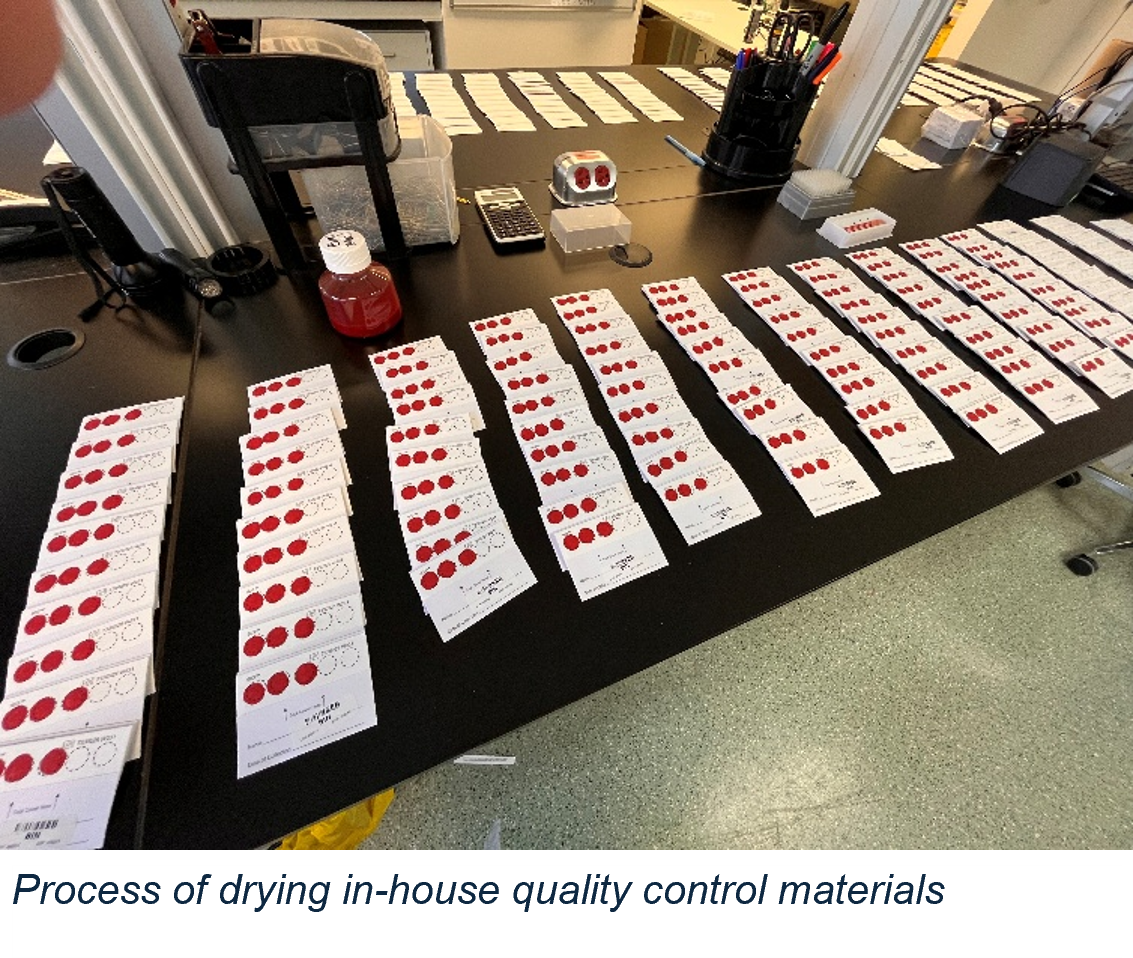
I also gained a deeper appreciation for the quality systems required to support newborn screening. Quality oversight includes dried blood spot specimen quality assessment (insufficient quantity, physically scratched, supersaturated, clotted, etc.), internal and external quality control, lot-to-lot comparison, long-term trend monitoring, and continuous review of screening performance. I learned how NSO’s quality practices account for the unique DBS matrix. For example, commercial quality control and external proficiency testing materials are provided as DBS. I also observed the preparation of in-house quality control materials, which involved spiking blood with high concentrations of target analytes, applying the material onto dried blood spot filter paper, and allowing it to dry to better mimic the patient sample matrix. These quality control materials are then punched and analyzed alongside patient specimens.
Expanding Screening Menu – “Can we screen for this condition?”
My visit was thoughtfully structured, and the final day felt like the “dessert” of a course meal that brought the whole week together. In a discussion with Dr. Neal Sondheimer (Medical Director) on adding conditions to the newborn screening menu, I learned that expansion of the newborn screening menu is not simply a matter of adding another laboratory assay. Since NSO was established at CHEO in 2006, its screening menu has expanded substantially, from phenylketonuria and congenital hypothyroidism to a broad panel of over thirty conditions. Conditions can be nominated for consideration through the “Test Addition Process” on the NSO website. This can be done by an individual or a group. Nominated diseases are evaluated using Wilson and Jungner screening criteria, including whether the condition is an important health problem, whether a suitable screening test exists, and whether early treatment improves outcomes. This was a great way to conclude my visit as it connected many themes I had encountered throughout the week, analytical aspects, clinical aspects, public health impact, drug availability, cost, and health equity.
Personal Reflections
I feel very fortunate to have had the opportunity to learn from a world-leading newborn screening laboratory rich in knowledge and experience. This visit helped me appreciate newborn screening not simply as a group of laboratory tests, but as a coordinated program that connects newborns and families, analytical techniques, clinical follow-up, and public health decision-making. It also gave me a unique opportunity to better understand dried blood spots as a clinical specimen. I am sincerely grateful to Dr. Nathalie Lepage, Dr. Matthew Henderson, Dr. Neal Sondheimer, Dr. Farah Elturk, Amy, Emily, Lester, Phil, and the entire NSO team for their warm welcome and generously sharing their expertise throughout the week. I am also very thankful to CSCC Council for supporting this trip through the CSCC Trainee Elective Visit Grant.