





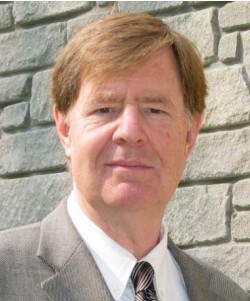
Tribute to Dr. Andrew R. MacRae (1946-2025)A leader, a legend –“Quanto Qualique Diagnoscere” |
 |
Submitted by: Christine Collier, CSCC Archives Committee, Laura M. MacRae, BSc, MSc, MD, CCFP and Heather C. MacRae-Maahs, BSc (Env.), MSc
Andrew (Andy) Richard MacRae was born in Cleveland, Ohio to Canadian parents – Margaret Elizabeth (Betty) and Donald Alexander MacRae. He was the youngest of three sons, with older brothers David and Charles. His father had an Astronomy faculty position at Case Western Reserve University when Andy was born in 1946. When he was seven years old, the family moved back to Canada to live in Toronto, where he attended John Ross Robertson Elementary School and then Lawrence Park Collegiate Institute.
Involvement in societal affairs came naturally to Andy: when he was nine years old, he organized a chess club, and in his early teens, he served as the President of a teenage cottagers association. Andy became interested in the field of biochemistry through his research in the field of nutrition and metabolism, obtaining his BSc in Physiology and Biochemistry from the University of Toronto (1968). He completed his MSc in Nutrition in 1971 at the University of Guelph under the supervision of Dr. Thomas S. Neudoerffer and finished his PhD in Nutritional Biochemistry in 1974 at the University of London (UK) at Guy’s Hospital with Professor Ian MacDonald, who was a leading researcher in the field of dietary carbohydrates. His external PhD thesis examiner was none other than Sir Hans Krebs. Andy completed the Diploma program in Clinical Biochemistry at the University of Toronto in 1976, and in 1986 he became a Founding Fellow of the CACB.
In 1977, Andy moved to Winnipeg and became Assistant Director in the Department of Biochemistry at St. Boniface General Hospital, with an appointment as Assistant Professor in the Department of Pathology at the University of Manitoba. While serving as President of the Manitoba Society of Clinical Chemistry (1978-80), he wrote new by-laws and created the MSCC Annual Lectureship Award. He was a member of the organizing committee for the 1978 CSCC national meeting and was active on the Province of Manitoba’s SI Units Steering Committee.
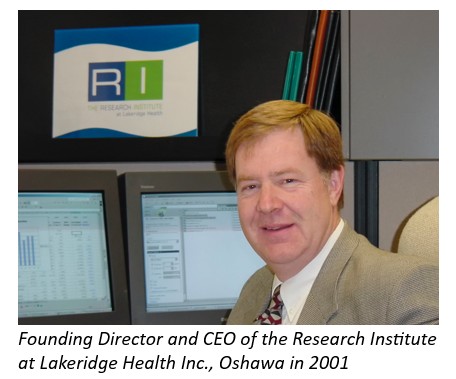
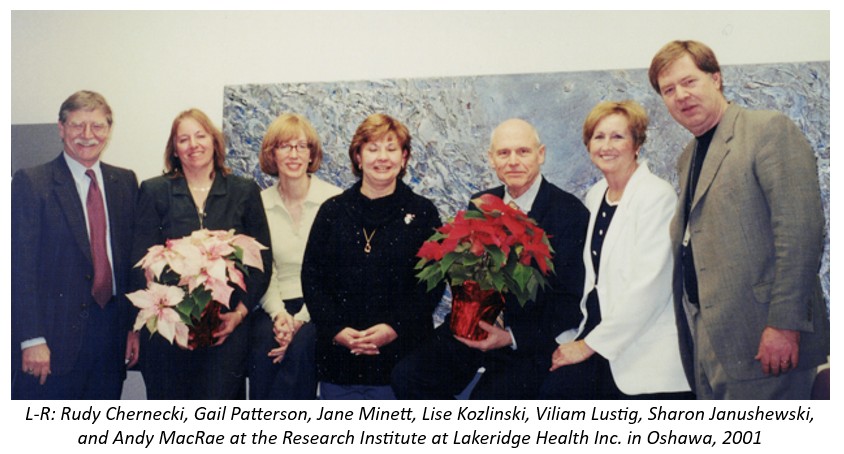
In 1982, Andy returned to Ontario and joined the Oshawa General Hospital as the Clinical Director, Section of Biochemistry, in the Department of Laboratory Medicine. Over the years he held a variety of positions as Oshawa General Hospital evolved to Lakeridge Health Corporation, including most remarkably, founding a Research Institute (RI) and serving as its Founding Director and CEO for several years. In 1983, Andy met Cathy (Catherine Henry) when they were both working at the Oshawa General Hospital. Cathy was the dietician assigned to work on the process of changing the units of measurement to the metric system for the dietary department, and Andy had been sent down to the dietary department to learn how their department was handling the conversion. The rest was history!
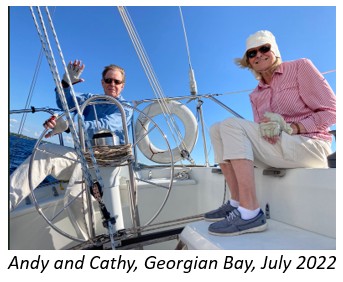
They were married in 1991, and in 1993 and 1996, their daughters Laura and Heather were born. The girls recall having a wonderful childhood, spending time with and learning from their dad, who loved teaching them things. He was always very methodical and precise with any project he took on, and he taught them the value of using proper measurement tools, taking time to think things through, and not rushing. He taught them to always work towards their goals and seek out opportunities for growth, even if they seemed difficult to achieve. 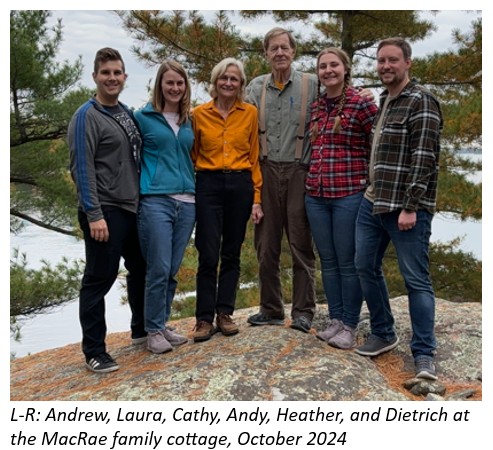 They always looked forward to sharing good news with their dad because they knew he would celebrate right alongside them, with great enthusiasm; their big life moments mattered to him just as much as they mattered to them, and he was always a great support. He also taught them the values of perseverance, determination, honesty, and integrity; he taught them generosity and gratitude, and to live a well-rounded life full of friends, love, and laughter. Andy loved filling his life outside of work with music, sailing, curling, and spending time on Georgian Bay. Some of the family’s best memories revolved around spending time together at the family cottage, while sitting and listening to music or being out on the water. Andy was part of many choirs in his lifetime; most recently, he was a member of the “Cellar Singers” choir in Orillia, and he also sang occasionally with the “Cathedral Singers of Ontario”, including a couple of times at St. Paul’s Cathedral in London, England.
Andy was editor of the CSCC newsletter from 1981 to 1984, during which time he increased its content, gave it a new look, recruited a new corporate sponsor, and re-wrote the terms of reference for the position of editor. He joined the OSCC as a councillor in 1984, becoming President of the Ontario Society of Clinical Chemistry (OSCC) from 1988 to 1989: again, he revised the by-laws and established the Annual Lectureship Award (OSCC). He also wrote three OSCC documents: Scope of Practice, Clinical Biochemistry; The Role of Clinical Biochemistry in the Protection of the Public; and Job Description, Clinical Biochemist. Andy was very active in fostering awareness among the OSCC members about pay equity and job evaluation processes; one of his noteworthy efforts was to respond to the omission of Clinical Biochemists from the Ontario Regulated Health Professions Act. Later, as a founding board member, he played a role in the formation of the College of Clinical Scientists of Ontario, a professional alliance of clinical biochemists, microbiologists, and geneticists in Ontario. He was the CSCC representative at the 1988 Royal Society of Canada meeting on the Public Awareness of Science and served as Chair of the CSCC Task Force on Strategies for Future Directions (1989-90). Andy has served on the Chemistry General Subcommittee of the Ontario Laboratory Proficiency Testing Program (1989-93), as the OSCC representative of the Advisory Committee to the Ontario Ministry of Health Laboratory Services Review (MOH,1992-94) and has been a member of various College of American Pathologists (CAP) Accreditation inspection teams.
Formation of the Canadian Academy of Clinical Biochemistry (CACB) in 1986 was an important step in the development and public recognition of the profession. Andy was involved in the discussions prior to and during the formation of the CACB, and he accepted the unique responsibility to liaise with the Chief Herald of Canada, Robert D. Watts, to get the Coat of Arms designed and approved.
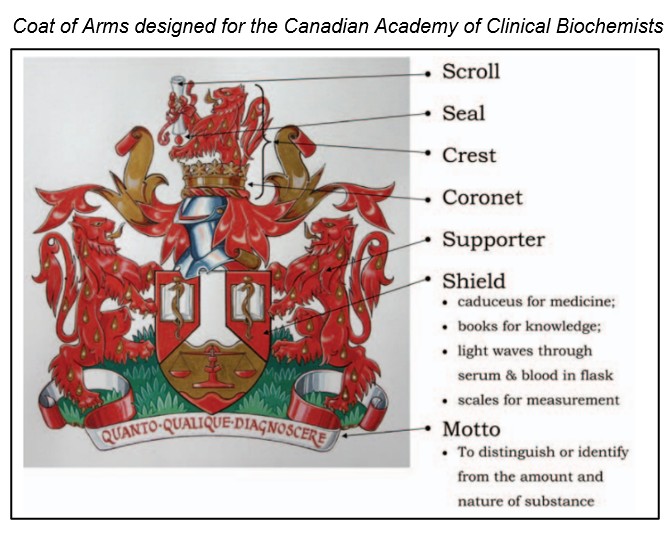
He devoted a lot of time and effort in identifying the elements to be included in the Coat of Arms, and did this so well that he was able to explain to his colleagues their scientific and their heraldic significance and relevance, culminating in the unveiling of the Grant of Arms and the Academy’s motto – Quanto Qualique Diagnoscere (“To distinguish or identify, from the amount and nature of substance”), at the CSCC 1991 meeting in Montreal and in several CSCC News articles for the 25th CACB anniversary in 2011.
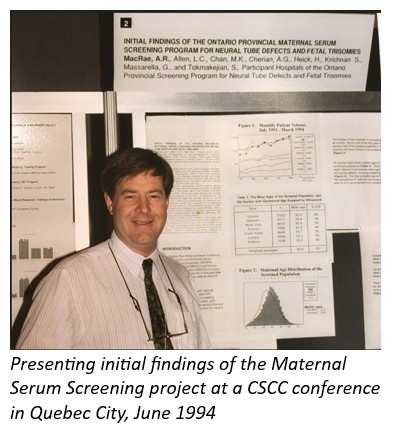 Andy was instrumental in developing and establishing the Maternal Serum Screening (MSS) program in Ontario and subsequently fostering its uniform adoption across Canada. He was a recognized member of the American Society of Human Genetics, Chair of the Ontario Interdisciplinary Consensus Group on Maternal Serum Screening, a member of the Ontario Central East Subcommittee of the Provincial Advisory Committee on Genetic Services (1989-91), and Co-Chair, Ontario Maternal Serum Screening Program ad hoc Implementation Committee (1993). He chaired the CSCC Task Force responsible for the CSCC Position Paper on MSAFP in Clinical Biochemistry (1990), which resulted in cross-discipline recognition of the CSCC within the North American clinical genetics communities. Andy also participated in the development of software for the calculation and interpretation of MSS tests, which was initially developed for use in Oshawa, and eventually used by more than 200 labs worldwide.
Troponin, troponin, troponin!! Andy, along with Pete Kavsak, Viliam Lustig, Man Khun Chan, Alan Jaffe, and other well-known colleagues have published an avalanche of papers on troponin (Tn) and multiple other markers for cardiovascular disease over the years (…luckily the repeat rate for publishing has been longer than every 2 to 3 hours!). This research has resulted in many peer-reviewed abstracts and publications (>30) at the national and international level and has helped improve and define appropriate laboratory testing and utilization and patient care for potential acute myocardial infarctions (AMIs) across Canada and globally. Their 2006 Clinical Chemistry paper “Assessing the requirement for the six-hour interval” (cited >157 times) was referenced in the 2007 NACB Laboratory Medicine Practice Guidelines for ACS&HF, the 2007 Universal Definition of Myocardial Infarction (Circulation), the ACS 2010 International Consensus and Recommendations, Tietz’ 2012 textbook, the Third Universal Definition of Myocardial Infarction in 2012, and the 2014 ACC/AHA non-SI-ACS guidelines, all highlighting the recommendation that: “Blood samples for the measurement of cTn should be drawn on first assessment and repeated 3-6 h later. Later samples are required if further ischemic episodes occur, or when the timing of the initial symptoms is unclear.”
The depth and breadth of Andy’s other efforts and achievements are as impressive. In the 1990s and 2000s, he applied for and received more than 23 grants and contracts worth millions of dollars as part of his efforts associated with founding and directing the RI at the Oshawa General Hospital. Funding agencies for these local, national, and international collaborations included the CIHR, US NIH, OAML, CHSRF, OHS Restructuring Commission, Ontario Ministry of Health, different diagnostic companies, and a variety of Hospital Foundations and Auxiliaries. For essentially all of these, Andy’s role was “Principal Investigator”! And in 2005, Andy was one of the original co-applicants with Eleftherios Diamandis and others for the development of the Ontario Cancer Biomarker Network (OCBN) – yet another significant effort.
Andy was a natural teacher and speaker, as well as a productive writer. He wrote two book chapters on Prenatal screening, one with J.A. Canick (2004) and one with D. Chitayat (2006); over 40 peer-reviewed articles and letters; at least 16 articles and monographs for newsletters (e.g. CSCC News, CAP today); and more than 76 abstracts. He shared a substantial amount of this work at invited talks, symposia, workshops and roundtables at a wide variety of national and international meetings over the years.
Stories from friends/colleagues:
Ron Martin did his BSc, MSc and PhD studies with Andy at the same time at the universities of Toronto, Guelph, and London (UK). He wrote: “Since the day I first met him in class at the University of Toronto, Andy seemed intrigued by any equipment beside him or any project in his view. He was inquisitive and he liked to tinker. At an early point in his studies in Life Sciences at University of Toronto, he was interested by chance to meet Dr. Hans Krebs, who was presenting a seminar on biochemistry. Dr. Krebs was famous for his work in metabolics, more specifically his studies on the biologic citric acid cycle which is linked to sugar metabolism. Andy became part of a group of students who were selected to meet with Dr. Krebs to welcome him. Andy and I talked about how he might open a conversation with the professor, and he suggested as a jest that he would start by saying how very much he admired Dr. Krebs’ cycle, as one would talk about a motorcycle! Much later in England, Dr. Krebs, who was now ‘Sir Dr. Hans Krebs’, became the external examiner for Andy’s PhD at Guy’s Hospital in London. His thesis included blood testing of patients to evaluate their sugar metabolism – and this was probably how Prof Krebs became interested in Andy’s work.”
Viliam Lustig (Clinical Biochemist) recalled: “The Research Institute (RI) at the Oshawa General Hospital was born in the year 1996. Andy had the brilliant idea to establish an RI for Clinical Chemistry in a community hospital. The CIHR provided some of the initial funding, and as time went by, the RI obtained financing from different funding agencies and commercial diagnostic companies. Andy, as CEO, assembled a team of dedicated researchers and I am proud to say that he offered me the position of Research Leader, which I eagerly accepted. Some of the early work centered on the measurement of markers of myocardial injury. Andy involved an emergency medicine physician and a cardiologist in our research, and we published several high impact papers on the topic. It was always a pleasure to work with Andy or just spend time with him. His command of the English language and knowledge of computers were astounding. Andy was amazingly kind. When there were snowstorms, Andy didn’t want me to drive home during rush hour, so he would invite me to dinner so I could drive home later when there was less traffic. I was fortunate to maintain a life-long friendship with Andy, and will miss his kindness, warmth and wit.”
Rudy Chernecki was a Board Member of the Oshawa Hospital Foundation (OHF) at the time of the initiation of the Research Institute (RI) in 1996: “I have vivid memories that creating a free standing, incorporated research institute was such a novel idea that had never been considered in a community hospital. When Andy came up with the idea, it fell on me as the only OHF board member who knew anything about or was interested in hospital research to ‘validate’ the RI idea before the entire foundation board heard Andy’s presentation and request for start-up funding. Up to that point, any research being done in a community hospital was usually conducted with drug company funding. The RI idea was to gather those in the hospital interested in research and other researchers from outside so that they could apply for agency grants that a hospital would not normally be eligible for and release the funding obligation and reliance on drug companies for in-hospital research. I convinced my fellow board members to invite Andy to a board meeting, the result of which was a start-up funding grant that, along with a CIHR grant, spun the RI into being. Andy recruited a fellow from Sunnybrook Hospital who invaluably served on our RI founding board and helped with the rules of incorporation and then did all the legwork himself to get the RI passed by the lawyers and government and into existence. In retrospect, the toughest hurdle we probably had to overcome at the hospital and foundation levels was to convince everyone that RI research was strictly on a bedside ‘need to know’ patient care basis as opposed to a ‘nice to know’ construct.”
Richard Wing, a fellow MSc student, recounts that: “When I first met Andy in September 1969, we shared the graduate students’ office in the Department of Nutrition at the University of Guelph. We shared this with another Brit, Mike Reidy. Mike and I had arrived in Guelph after completing our first degrees in nutrition at the University of London, UK. This was the only UK establishment offering a degree in human nutrition at that time. We were heavily influenced by Professor John Yudkin who in 1972 published his book ‘Pure White and Deadly.’ This cited sugar consumption as a major causative factor in heart disease. The book was not well received as excessive fat intake was regarded as a major cause of heart disease at that time. Mike and I would discuss this at length with Andy, and I believe this stimulated his interest in the effects of dietary carbohydrates. Indeed, after finishing his master’s at Guelph he undertook his doctorate at Guy’s Hospital Medical School in London under the guidance of Professor Ian MacDonald who was a leading researcher in the field of dietary carbohydrates. During our time together in Guelph, I was always impressed by his quick wit and enthusiasm for his work. We introduced him to the sport of rugby, playing on the University team – he learned fast and became a quick strong wing forward. In the UK, he played a few times for my ‘old boys’ rugby team. I returned to teach in England and in later years had the pleasure of hearing his choir sing in Southwark Cathedral. Our families are grateful for our friendship and many fond memories over the years.”
Man Khun Chan (Senior MLT) reflected that: “The Maternal Serum Screening Program was very dear to Andy. Together, we put a lot of work into the program, sometimes late into the evening in his office, at the same time having a lot of fun doing it. We also brought the work home. My home computer had only a very small hard drive (25 megabytes), so Andy had one of his computer friends come to my house to upgrade my hard drive to 50 megabytes! Fun story: I arrived in Canada from England on Christmas Eve 1989 and started to apply for Medical Laboratory jobs in January 1990. I received a response from Andy (Oshawa General Hospital) to come to Oshawa for an interview and that he would pick me up from the train station. It was Andy that gave me a good start in Canada, and I am forever grateful to him – we got along well, and I will remember him fondly.”
 Glenn E Palomaki (Professor, Brown University, Providence, RI) recalled: “Our group, including Dr. Jack Canick, Dr. George Knight and I, collaborated with Andy on at least 14 publications beginning in 1993. This included the CIHR SAFER study (first and second trimester evaluation of Down Syndrome using maternal serum PAPP-A and inhibin-A with other markers) and several other collaborations. I missed an opportunity to see Andy outside of work when he invited me to go sailing. Unfortunately, I didn’t find the time but wish I had – Andy was friendly to all. I and many others will miss his presence.”
Pete Kavsak (Clinical Biochemist), reminisced: “I was drawn to Andy’s research and vision for expanding and conducting research in the community hospital setting during my fellowship. At the time, Andy was already well known in the maternal serum screening field. He had also conducted a study back in the 1990s on patients with possible myocardial infarction in the emergency department. What was unique about this study was the hourly sample collection and long-term storage of the samples to build a ‘Cardiac Markers Serum Specimen Bank.’ A decade later, I was fortunate to lead studies on new biomarker testing on this precious archived sample set. I am so grateful for all the support, advice, and opportunity Andy and those at the RI provided me: after 20 plus years, I have failed to experience the amazing environment that was the RI – great projects coupled with great people is a combo that’s hard to replicate. Andy and I stayed in touch – it was a pleasure (& task) to read Andy’s emails which were lengthy (and sent often very late in the day or early in the new day) but were beautifully written with great insights. Andy’s intellect was evident; however, what I will most fondly remember was his humor, his constant support, his cheerleading, and kindness.”
Christine Collier (Clinical Biochemist) remembers Andy as a wonderful teacher, mentor, and colleague: “His commitment, contributions, and leadership to the profession of Clinical Biochemistry in Ontario and in Canada were exemplary, contributing very much to the quality and high level of functioning and success that our societies and members, other medical specialties and the public, have benefited from over many decades. I intuitively attempted to follow his lead, assuming that that was just how committed a clinical biochemist should be! I believe he was right, as most of us have thoroughly enjoyed our careers. His efforts on the maternal serum screening program, the CACB Grant of Arms, and research on troponin were some of his important contributions. What I appreciated most was his ongoing support and interest in not only the society, but also in his colleagues. He was always available to consult and help when he got a call. Andy was very much appreciated and will be missed.”
Andy has been recognized with three Outstanding Contribution awards: “to the CSCC” (1995), “in the Profession of Clinical Biochemistry” (OSCC, 1997) and “to Clinical Chemistry” (CSCC, 2012). The end of Andy’s commendation for the 1995 award, concluded: “The list of contributions by Andy to the CSCC, either directly or through his work with related societies, clearly demonstrates remarkable dedication and expertise offered over many years in a wide variety of areas.” It noted that George Luxton once remarked: “Following Andy in a societal position is very difficult because Andy actually does things!” For over 40 years, Dr. Andrew (Andy) MacRae was an amazingly productive and enthusiastic Clinical Biochemist with major contributions in service, administration, teaching and research while meaningfully promoting and improving patient care and health care as well as the profession at the provincial, national, and international levels – thank you Andy! And thanks to his family, friends and colleagues who supported him. It takes a village, and he was a vital part of many villages!”
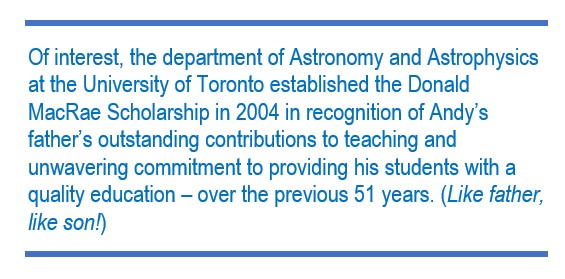
Further Reading: CSCC News: Awards – Feb 1995,1997, 2012; CACB Coat of Arms – July, Sept, Dec 2011; Andy’s Dad: Donald MacRae Scholarship in 2004 (https://www.astro.utoronto.ca/about/history/donald-alexander-macrae/teaching-and-public-outreach/the-donald-macrae-scholarship/ )