





Diving into the Creative Solutions for Global Challenges in TDMCT
Submitted by Dr. Lei Fu, recipient of the 2025 CSCC Grant for Leadership and/or Administration
The 23rd Congress of the International Association of Therapeutic Drug Monitoring and Clinical Toxicology (IATDMCT 2025) was held at the Grand Copthorne Waterfront Hotel, Singapore, from September 21 to September 24, 2025. More than 500 delegates, including pharmacists, toxicologists, laboratory medicine professionals, and researchers from around the world came together to address global challenges through creative solutions in therapeutic drug monitoring (TDM) and clinical toxicology. As stated by the Congress Theme—Creative Solutions for Global Challenges—the congress focused on expanding methodologies, optimizing resource-limited practices, tackling complex anti-infective scenarios, and exploring innovative approaches to TDM in diverse settings.
This congress kicked off with a Keynote Address by Dr. Kevin Plaxco, from the University of California, Santa Barbara: “Real-time Monitoring of Drugs, Metabolites and Biomarkers: Recent Advances in vivo Biosensors.” This inspirational lecture highlighted the recent technological development of the Electrochemical Aptamer-based platform and several advances in pharmacology and physiology enabled by this uniquely high-time-resolution, real-time window into the body’s molecular status.
Over the following three days, the congress program was packed with three plenary lectures, twenty scientific symposiums, twelve oral presentation sessions, ten walking poster sessions, and several industry workshops, vendor exhibitions, and networking events. The program covered a wide range of topics in TDM and toxicology. To just name a few: TDM in oncology, pharmacometrics, prospective implementation of pharmacogenomics in clinical practice, next generation sequencing (NGS) versus targeted genotyping strategies, integration of pharmacogenetics and therapeutic drug monitoring in oncology practice, immunosuppressive drugs & biomarkers, and simplifying drug assays for low resource environments. The full program and abstract book can be found at: https://www.iatdmct2025.org/program/.
The pre-congress workshops held on the Sunday were also well received. The one I attended was titled “Enhancing Review Article Writing with the Latest Tools, Including Generative AI.” This hands-on workshop guided participants in leveraging generative artificial intelligence (AI) tools for efficient literature searching and collaborative review article drafting. It introduced AI-powered platforms along with tools for reference management, collaborative writing and Large Language Models (LLM). This practical workshop demonstrated how AI tools can modernize the review-writing process, offering valuable overview on available platforms. AI is indeed a timely topic. Since ChatGPT became a ubiquitous computing AI tool in late 2022, generative AI and LLM tools have been rapidly developed and deployed. AI’s influence on society has never been more pronounced and has started to touch many aspects of modern life, including academic and healthcare environments.
Thanks to the generous support of the CSCC Grant for Leadership and/or Administration in 2025, I was able to attend this year’s IATDMCT congress. I participated in the Pharmacogenetics Scientific Committee meeting. It was a great opportunity to meet the committee chairs and members in person and to contribute to the committee’s activities. At Symposium 7, “Creative Solutions for Global Challenges in Fentanyl Monitoring and Toxicology,” chaired by Drs. Ofelia Noceti and Danijela Kocic, I presented “Detection and Monitoring Fentanyl Use and Misuse in Patients Presented in Emergency Room and Out-Patient Substance Use Clinics.” For Oral Presentation 11, Pharmacogenetics, my collaborator Dr. David Yuan from the European Bioinformatics Institute also shared our experience in developing an end-to-end bioinformatics solution to support NGS-based pharmacogenetic testing.
Sponsored by the IATDMCT Scientific Committee, Clinical Toxicology & Drugs of Misuse, I had the privilege to work with my CSCC colleagues Drs. Cristiana Stefan, Benjamin Jung, Janet Zhou, and Loralie Langman as well as the committee chair Dr. Eric J. F. Franssen from the Netherlands on a review article titled “Urine Drug Testing: Service Models and Laboratory Practices to Meet Clinical Care Needs,” During the congress, I had the opportunity to discuss our manuscript with Drs. Stefan, Langman, and Franssen in person. We were able to exchange ideas effectively and revise our manuscript efficiently. I am pleased to report here that our article was accepted soon after the congress and will be published in IATDMCT’s official journal, Therapeutic Drug Monitoring.
I am grateful for the support of the CSCC grant that allowed me to attend this year’s IATDMCT congress. I have found the congress both professionally and personally rewarding. The congress provided a broad and enriching platform for the participants to learn, connect, and collaborate towards finding creative solutions for global challenges in TDM and clinical toxicology.
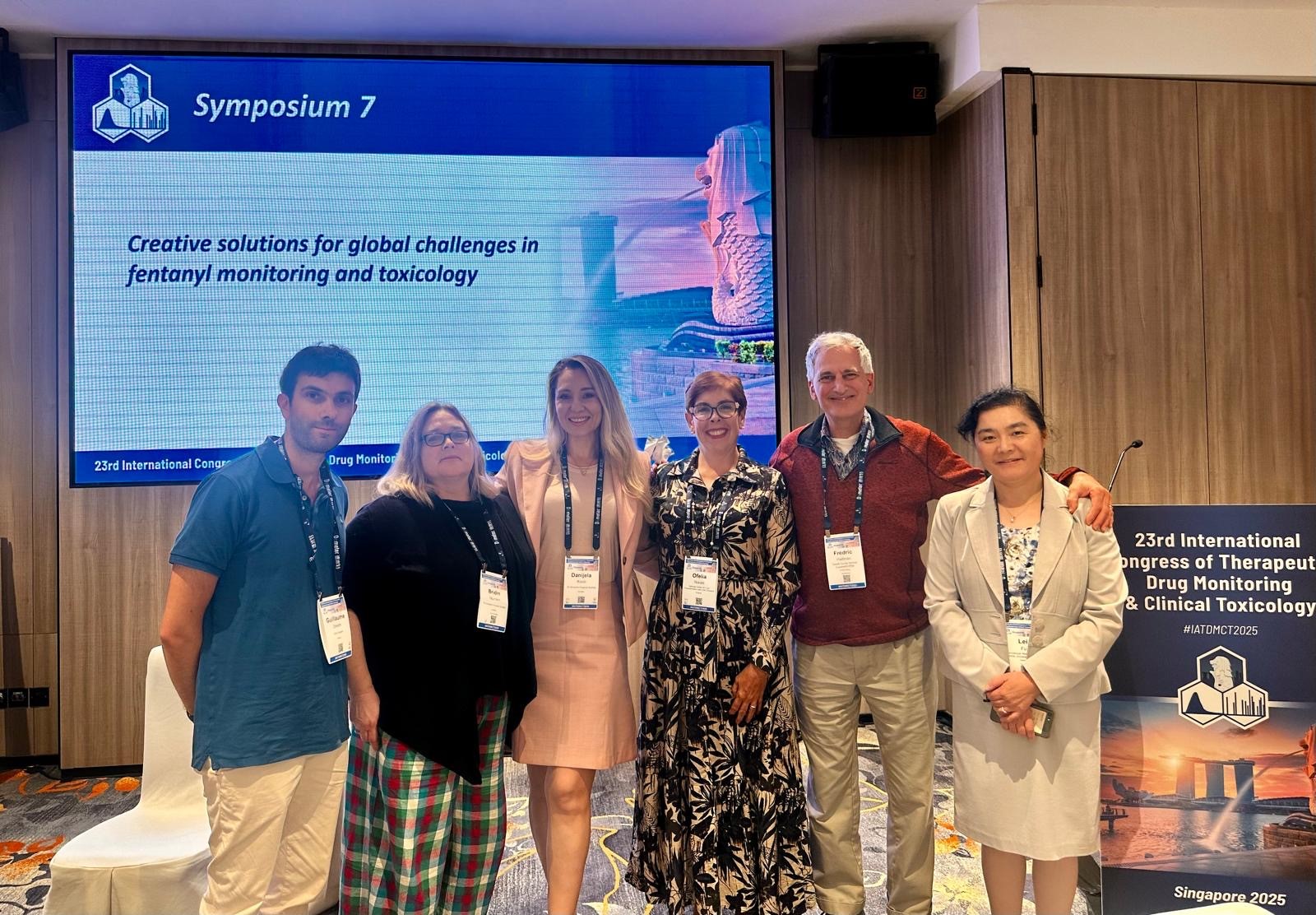
Speakers and session chairs of Symposium 7 at IATDMCT 2025
L-R: Dr. Guillaume Drevin, Centre Hospitalier Universitaire d’Angers, France; Dr. Bridin Murnion, St. Vincent’s Hospital, Sydney, Australia; Dr. Danijela Kocic, St Vincent’s Hospital, Sydney, Australia; Dr. Ofelia Noceti, National Center of Liver Transplantation and Liver Diseases, Montevideo, Uruguay; Dr. Frederic N. Hellman, Dekalb County Medical Examiner’s Office, Decatur, Georgia, USA; Dr. Lei Fu, Sunnybrook Health Sciences Centre and University of Toronto, Canada
The 2026 CSCC Grant for Leadership and/or Administration is open for applications. Details about how to apply for the grant can be found on the CSCC Website/About Us/CSCCAwards&Grants – CSCC Awards & Grants | CSCC